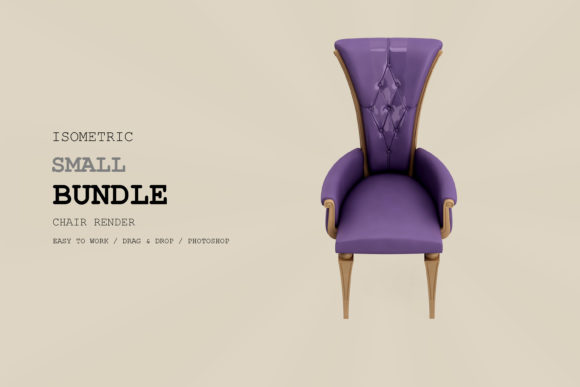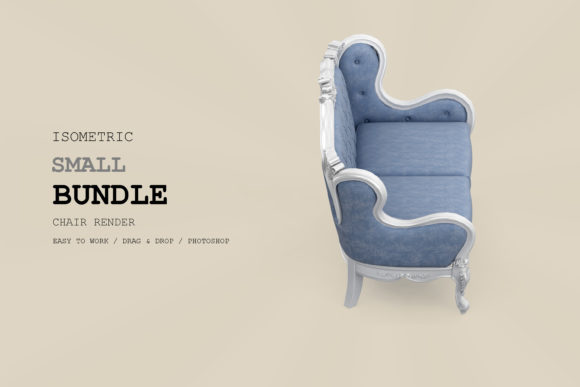
Isometric Armchair 3D Rendering Pack 40
In the landscape of digital design, consistency and speed are often the defining factors between a good project and a great one. Whether you are constructing a virtual showroom for an e-commerce platform or drafting a visual aid for an educational module, the integrity of your assets matters just as much as the composition of your layout. This is where specialized asset packs become indispensable tools in a designer’s workflow. The Isometric Armchair 3D Rendering Pack 40 represents a targeted solution for professionals who require high-fidelity, stylistically consistent furniture elements without the time-consuming overhead of modeling from scratch.
This pack is not merely a collection of images; it is a structured resource designed to integrate seamlessly into various creative and technical pipelines. By providing separated backgrounds, organized layers, and precise shadowing, it allows users to manipulate these armchairs with the same precision they would apply to their own original work. Understanding how this pack fits into broader processes—from initial concepting to final delivery—can significantly enhance productivity and output quality.
Technical Specifications and Workflow Integration
The utility of any digital asset is determined by its technical readiness. The Isometric Armchair 3D Rendering Pack 40 is engineered to minimize friction during the implementation phase. At the core of its value proposition is the separation of elements. Each rendering comes with a separated background, meaning the armchair is isolated on a transparent or neutral layer. This feature is critical for designers working in software like Adobe Photoshop, Illustrator, or Figma, as it eliminates the tedious process of manual masking or clipping paths. You can drop the asset directly into your composition, knowing it will blend naturally with your chosen backdrop.
Furthermore, the inclusion of a separated shadow adds a layer of realism that is often difficult to achieve manually. Shadows ground objects in a space, providing depth and context. In an isometric view, where perspective is fixed and mathematical, accurate shadow placement is essential for maintaining visual coherence. With the shadow provided as a distinct layer, you can adjust its opacity, angle, or color to match the lighting conditions of your specific project environment. This flexibility ensures that the armchair does not look like a flat sticker pasted onto a canvas but rather an object occupying physical space within your design.
Resolution and Print Readiness
One of the most common pitfalls in using stock assets is encountering pixelation when scaling up for larger formats. The High resolution of the renders in Pack 40 addresses this concern head-on. Specifically, the assets are delivered at DPI 300, which is the industry standard for high-quality print materials. This specification ensures that whether you are designing a small business card or a large-format poster, the details of the armchair’s texture, stitching, and form remain crisp and clear.
This level of detail is particularly important for industries where tactile perception translates to digital trust. For instance, in interior design or furniture retail, potential clients rely on visual cues to gauge quality. A blurry or low-resolution image can inadvertently suggest cheap manufacturing, whereas a sharp, 300 DPI render conveys professionalism and attention to detail. By utilizing assets that meet print standards, you future-proof your work, allowing for easy repurposing across both digital and physical mediums without needing to source new graphics.
Organizational Efficiency Through Layer Management
For designers who manage multiple projects or complex compositions, file organization is a silent killer of productivity. The Organized layers feature within the Isometric Armchair 3D Rendering Pack 40 is a testament to thoughtful asset creation. Instead of a single flattened image, the files contain grouped and labeled layers. This structure allows for non-destructive editing. You might want to change the color of the upholstery, remove the legs, or isolate the armrests for a specific effect. With properly organized layers, these modifications are straightforward tasks rather than reconstruction projects.
This organizational aspect also aids in collaboration. When handing off files to a team member or a client, clean layer structures make it easier for others to understand your workflow and make necessary adjustments. It reduces the cognitive load required to navigate complex documents, allowing you to focus on the creative direction rather than the technical mechanics of the file itself.
Practical Applications Across Industries
The versatility of the Isometric Armchair 3D Rendering Pack 40 makes it suitable for a wide array of use cases. Its adoption is not limited to a single niche but spans across education, marketing, architecture, and content creation. Below are several practical scenarios where this pack can be integrated effectively.
- School Projects: In academic settings, students often need to create professional-looking presentations or portfolios. Using high-quality 3D renders can elevate the visual appeal of school projects, helping students communicate their ideas more effectively. The ease of use provided by the separated layers means that even those with limited graphic design experience can produce polished results.
- Social Network Content: Social media algorithms favor engaging visuals. Isometric illustrations have gained popularity on platforms like Instagram and Pinterest due to their clean, modern aesthetic. Incorporating the armchair renders into infographics, mood boards, or promotional posts can increase engagement rates. The high resolution ensures that images look sharp on retina displays and mobile devices alike.
- Print Projects: From brochures to catalogues, print materials demand high fidelity. The 300 DPI specification of this pack makes it ideal for creating tangible marketing collateral. Designers can place the armchairs into lifestyle scenes or product showcases, confident that the output will meet commercial printing standards.
- Architecture Design: Architects and interior designers often need to visualize spaces quickly. While full 3D models are powerful, they can be time-intensive to set up. Using pre-made 3D renders as placeholders or final assets in 2D floor plans allows for rapid prototyping. The isometric perspective provides a clear overview of how furniture fits within a room layout, aiding in spatial planning and client presentations.
- Blog and Website Content: Digital publishers use visuals to break up text and illustrate concepts. An article about home office ergonomics, for example, could benefit from custom illustrations featuring comfortable armchairs. The separated backgrounds allow these images to be easily integrated into web layouts with varying color schemes, ensuring brand consistency across the site.
- Advertisement: In competitive advertising landscapes, unique visuals help brands stand out. Customizing the armchair renders—perhaps by changing colors or combining them with other elements—allows marketers to create bespoke advertisements that feel tailored rather than generic. This customization capability is key to building a strong brand identity.
Implementation Tips and Best Practices
To get the most out of the Isometric Armchair 3D Rendering Pack 40, consider integrating it into your workflow early in the planning stage. Rather than treating it as an afterthought, identify opportunities where consistent, high-quality furniture visuals are needed. Start by reviewing your project brief and noting where these assets can add value.
When implementing the renders, pay attention to lighting consistency. Although the shadows are separated, ensure that the direction and intensity of the light in your composition align with the shadows provided. If your scene requires a different lighting angle, you may need to adjust the shadow layer’s properties or composite multiple shadows to achieve realism. Additionally, experiment with blending modes to see how the armchair interacts with your background textures. Modes like "Multiply" or "Overlay" can help the asset feel more integrated into the environment.
Another practical tip is to maintain a library of customized versions of these renders. Since the layers are organized, you can save variations of the armchair in different colors or configurations. This creates a reusable asset library that saves time on future projects. Over time, this habit of accumulation and organization pays dividends, reducing the need to search for new assets and allowing you to focus on innovation and strategy.
Conclusion
The Isometric Armchair 3D Rendering Pack 40 offers more than just pretty pictures; it provides a robust foundation for efficient design workflows. Its features—ranging from separated backgrounds and shadows to high resolution and organized layers—are specifically chosen to support professional standards and creative flexibility. Whether you are a freelancer looking to streamline your deliverables, an educator seeking engaging materials, or a marketer aiming to capture attention, this pack serves as a reliable tool in your arsenal. By understanding its capabilities and integrating it thoughtfully into your processes, you can enhance the quality and impact of your visual communications.